
English rugby has always valued structure, discipline, and physical strength.
For decades, these qualities defined how teams trained, how matches unfolded, and how success was measured.
Yet over the last fifteen years, the sport has entered a period of visible adjustment. The modern game moves faster, collisions arrive more frequently, and recovery time shrinks. English rugby has not resisted this shift. Instead, it has adjusted step by step, often quietly, but with clear intent.
Many supporters first notice these changes while watching matches, reading analysis, or browsing sports-related content online. During that wider exploration of entertainment and sport, references to platforms such as piper spin appear naturally, reflecting how rugby now exists within a broader digital sports culture rather than as a self-contained tradition. The sport still respects its roots, but it no longer relies on them alone.
Understanding how English rugby adapts requires looking at training, tactics, player profiles, and even how matches get managed from the sidelines.
The game moves quicker than it used to
One of the most obvious changes lies in tempo. Matches now unfold at a higher pace, with less downtime between phases. Referees enforce laws that encourage continuous play, and teams respond by maintaining intensity for longer periods.
Where older matches often slowed around set pieces and breakdowns, modern games flow more freely. Players cover more ground, and the ball stays in play longer. This shift places new demands on conditioning and decision-making.
Conditioning becomes central, not optional
Fitness standards across English rugby rose sharply. Players no longer train only for strength and endurance. They prepare for repeated high-speed efforts combined with heavy contact.
Training programs now focus on:
- Short-distance acceleration
- Rapid recovery between collisions
- Sustained intensity over eighty minutes
- Flexibility to reduce injury risk
This approach reflects the reality of modern matches rather than traditional expectations.
Player profiles continue to evolve
The physical profile of players changed alongside the game. Forwards remain powerful, but they also need mobility. Backs still rely on speed, yet they face heavier contact than before.
English rugby prioritises athletes who combine size with movement. Players who struggle to keep pace often fall behind, regardless of technical skill.
Skill under pressure matters more
Speed affects decision-making. Players now make choices under greater physical and mental pressure. Handling skills, passing accuracy, and positioning become critical when time disappears.
Coaches emphasise execution at speed. Training sessions replicate match conditions closely, forcing players to perform while fatigued.
Tactical structures adapt to tempo
English rugby once relied heavily on territory and set-piece dominance. While these elements still matter, teams now blend them with quicker attacking patterns.
Attacking structures encourage rapid ball movement and support lines. Defences must reset faster and communicate constantly to stay organised.
The breakdown becomes a battleground
The breakdown remains central, but its role evolved. Faster recycling of the ball forces defenders to retreat quickly. Delays lead to gaps.
Teams train breakdown efficiency intensively. Players learn to arrive quickly, clear effectively, and release just as fast. This skill set supports tempo without sacrificing control.
Defensive systems tighten
Faster games demand sharper defence. Missed tackles create immediate danger. English teams now focus heavily on line speed and spacing.
Defensive drills prioritise:
- First contact dominance
- Quick regrouping
- Communication under fatigue
This discipline allows teams to survive extended pressure.
Law interpretations influence style
Law interpretations play a significant role in shaping the game. Referees encourage quicker restarts and penalise slowing tactics.
English rugby responds pragmatically. Teams adjust behaviour to avoid penalties rather than resist enforcement. Discipline becomes a strategic necessity.
Substitutions gain tactical importance
With intensity rising, substitution strategies change. Coaches manage player workloads carefully to maintain tempo throughout the match.
Substitutes no longer simply replace tired players. They enter with specific roles, often to increase speed or physical impact during key phases.
Injury prevention takes priority
The physical demands of modern rugby increase injury risk. English clubs invest heavily in prevention, monitoring, and recovery.
Medical teams track workload, sleep, and muscle fatigue. Training adapts when risk rises. This approach protects players while sustaining performance levels.
Recovery becomes part of training
Recovery no longer sits outside preparation. It forms a core component. Ice baths, physiotherapy, and structured rest days support long-term output.
Players who recover well maintain consistency. Those who neglect recovery struggle to keep pace.
Youth development aligns with modern demands
Youth systems adjust to reflect senior rugby. Young players train for speed, coordination, and awareness rather than size alone.
Academies emphasise skill development alongside physical growth. This balance prepares players for the modern game rather than an outdated version.
Coaching methods evolve
Coaching adapts alongside the sport. Sessions shorten but intensify. Feedback becomes immediate. Video analysis plays a daily role.
Coaches encourage adaptability. Players learn to read situations rather than follow rigid scripts. This flexibility proves vital in fast-moving matches.
Data supports decision-making
Data analysis informs training and tactics. Coaches monitor player movement, collisions, and workload. This information shapes preparation.
Data does not replace intuition. It supports it. Coaches still rely on experience, but with clearer insight.
Set pieces remain important, but faster
Scrums and lineouts still matter. They provide structure and attacking platforms. The difference lies in speed.
Teams restart play quickly after set pieces. The aim is to exploit defensive organisation before it settles.
Kicking strategies change
Kicking remains a tactical tool, but its use shifts. Instead of purely territorial kicks, teams look for contestable kicks that maintain pressure.
This approach aligns with a faster game. Possession stays contested rather than conceded.
Match officials shape expectations
Officials influence tempo through consistency. English teams adjust quickly when interpretations change.
This responsiveness reduces penalties and supports flow.
Support staff grow in importance
Modern rugby relies on expanded support teams. Analysts, conditioning coaches, and medical staff work alongside head coaches.
This structure supports players through a demanding season.
Fan experience reflects the pace
Faster matches change how fans engage. Continuous action increases intensity and reduces long pauses.
Broadcasts highlight physical collisions and speed metrics, reinforcing awareness of change.
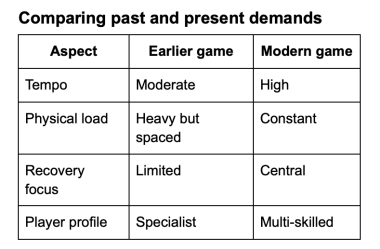
The comparison highlights how demands broadened rather than simply increased.
Balancing tradition and progress
English rugby still values discipline, structure, and set-piece strength. These traits remain competitive advantages.
The difference lies in how they integrate with speed and intensity. Tradition supports adaptation rather than blocking it.
Mental resilience gains importance
Faster games test mental endurance. Mistakes happen quickly. Players must reset instantly.
Mental conditioning receives greater attention. Focus, communication, and composure matter as much as physical readiness.
Club and international alignment improves
Clubs and national teams work more closely to manage player workload. Shared objectives reduce conflict.
This coordination supports consistency and reduces injury risk.
Player leadership evolves
On-field leadership adapts to tempo. Captains communicate efficiently and make quick decisions.
Leadership becomes practical rather than symbolic.
Refined preparation for big matches
Preparation for major fixtures now includes scenario planning. Teams rehearse late-game intensity and rapid shifts.
This preparation supports composure under pressure.
Public perception of physicality
Fans notice increased physicality. Collisions appear heavier because they happen more often.
This perception aligns with data showing higher contact frequency.
Managing player welfare long term
Long-term welfare remains a concern. English rugby continues refining rules and protocols to protect players.
This effort balances competitiveness with responsibility.
Why adaptation remains necessary
Rugby evolves globally. Teams that fail to adapt lose ground. English rugby recognises this reality.
Adaptation ensures relevance without abandoning identity.
Challenges still exist
Not all adaptations succeed immediately. Balancing speed, safety, and tradition requires constant review.
Mistakes occur, but learning follows.
Looking ahead
Future changes will likely focus on sustainability. Managing physical load while maintaining intensity will define success.
Innovation will continue, guided by evidence and experience.
Conclusion
English rugby adapts to a faster, more physical game through practical change rather than dramatic reinvention. Training methods, player profiles, tactics, and support systems evolve to meet modern demands. The sport retains its core values while adjusting to increased tempo and contact.
This balance explains why English rugby remains competitive. It respects where it came from while acknowledging what the modern game requires. By adapting thoughtfully, the sport continues to move forward without losing its character.