Europe crowned a new Eurovision champion on Saturday night as Bulgaria’s Dara stormed to victory with the absurdly catchy “Bangaranga”, while the United Kingdom finished stone dead last yet again, a result most Britons will probably greet with a mixture of indifference, sarcasm and a few jokes about Europe still being upset over Brexit.
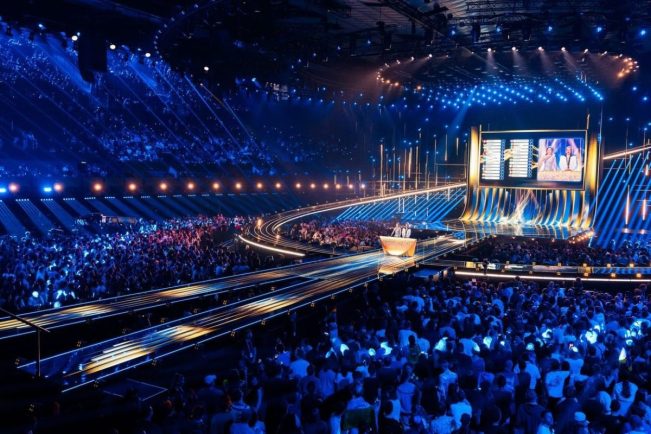
The 70th Eurovision Song Contest was supposed to be a glittering celebration of Europe’s biggest musical spectacle. Instead, Vienna hosted one of the strangest, most politically charged and downright chaotic editions in the competition’s history.
In the end, Bulgaria emerged victorious for the first time, with Dara’s infectious pop anthem racking up an emphatic 516 points. Israel’s Noam Bettan finished second after leading the scoreboard for much of the night, while Romania completed the top three.
Britain, meanwhile, received one solitary jury point and the dreaded nul points from the public.
Yet unlike many Eurovision nations, there is little sense of national trauma in the UK after another humiliating finish. Eurovision here occupies a strange cultural space, hugely watched, heavily mocked and rarely treated as a serious measure of musical credibility.
And perhaps that is understandable.
The United Kingdom remains Europe’s undisputed heavyweight when it comes to producing globally successful music. From The Beatles and Queen to David Bowie, Spice Girls, Oasis, One Direction, Ed Sheeran and Adele, British artists have dominated global popular culture for decades.
Eurovision, however, exists in an entirely different universe, one where pyrotechnics, novelty acts, tactical voting and geopolitical theatre often matter just as much as the music itself.
This year, the politics threatened to overwhelm the entire contest.
Five countries boycotted Eurovision over Israel’s participation amid the ongoing war in Gaza, while pro-Palestinian demonstrations took place across Vienna throughout the weekend. There were audible reactions inside the arena whenever Israel climbed the leaderboard, and social media quickly descended into furious arguments over whether countries should or should not be allowed to compete at all.
It all raised an awkward question, whatever happened to Eurovision’s long-standing claim of being apolitical?
For decades, organisers have insisted the contest is about music, unity and cultural exchange. Yet each year it becomes increasingly entangled in international disputes, public campaigns and diplomatic tensions. By the closing stages of the voting, Eurovision 2026 often felt less like a song contest and more like a televised geopolitical summit with glitter cannons.
That is not the fault of Israel’s contestant, who delivered a polished and professional performance throughout the week. Nor is it entirely the fault of audiences reacting emotionally to real-world events. But it does expose the contradiction at the heart of modern Eurovision.
The contest cannot repeatedly insist politics has no place on stage while politics dominates almost every conversation surrounding it.
Away from the controversy, there was still plenty of classic Eurovision absurdity.
Finland arrived armed with explosive staging and an electric violinist. Australia sent an actual chart star in Delta Goodrem, who finished fourth. Austria’s hosting duo somehow delivered a presenting performance so awkward it often felt like an unplanned rehearsal accidentally broadcast live across Europe.
Then there was Britain.
The BBC once again managed the remarkable feat of representing one of the greatest music producing nations on Earth with an act that looked as though it had been discovered five minutes before boarding the flight to Vienna.
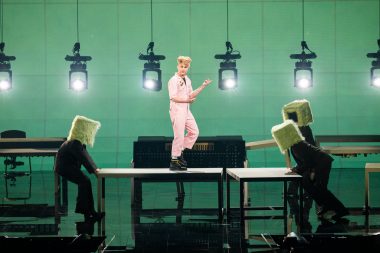 LOOK MUM NO COMPUTER performing Eins, Zwei, Drei for United Kingdom : Photo Credit: Corinne Cumming/EBU
This is the country that gave the world stadium filling rock bands, global pop icons and some of the bestselling artists in music history. Yet every May the BBC appears determined to send either novelty, irony or chaos dressed up as “quirky creativity”.
This year’s gamble was YouTuber and eccentric musician Look Mum No Computer, whose bizarre electro novelty performance involved homemade synthesiser gadgets, frantic staging and counting in German. Europe decisively rejected it.
At some point, serious questions have to be asked about whether the BBC actually understands modern British music at all. Eurovision may be gloriously silly, but the countries that consistently succeed still send polished, contemporary acts with songs audiences might genuinely stream afterwards.
Britain, by contrast, often behaves like it is entering a student union talent contest ironically and then acting surprised when it finishes last.
That does not mean Eurovision itself is irrelevant. The contest still attracts enormous global audiences and occasionally produces genuine international hits. Bulgaria’s “Bangaranga”, ridiculous title and all, was undeniably effective pop music, memorable, energetic and impossible to get out of your head after one listen.
But Eurovision 2026 will probably be remembered less for Bulgaria’s victory than for the wider chaos surrounding it.
An event supposedly built around unity exposed Europe’s divisions once again. A competition that claims to avoid politics became consumed by political debate. And Britain, as ever, sat at the back laughing at the whole farce while collecting almost no points whatsoever.
And so Eurovision rolls on to Bulgaria in 2027, where Europe will once again insist it is “all about the music”, right before awarding 12 points based on geopolitics, glitter cannons and whichever country remembered to bring a man on a flaming violin.
The final scoreboard:
Bulgaria, Dara – 516
Israel, Noam Bettan – 343
Romania, Alexandra Căpitănescu – 296
Australia, Delta Goodrem – 287
Italy, Sal Da Vinci – 281
Finland, Linda Lampenius x Pete Parkkonen – 279
Denmark, Søren Torpegaard Lund – 243
Moldova, Satoshi – 226
Ukraine, Leléka – 221
Greece, Akylas – 220
France, Monroe – 158
Poland, Alicja – 150
Albania, Alis – 145
Norway, Jonas Lovv – 134
Croatia, Lelek – 124
Czechia, Daniel Žižka – 113
Serbia, Lavina – 90
Malta, Aidan – 89
Cyprus, Antigoni – 75
Sweden, Felicia – 51
Belgium, Essyla – 36
Lithuania, Lion Ceccah – 22
Germany, Sarah Engels – 12
Austria, Cosmo – 6
United Kingdom, Look Mum No Computer – 1