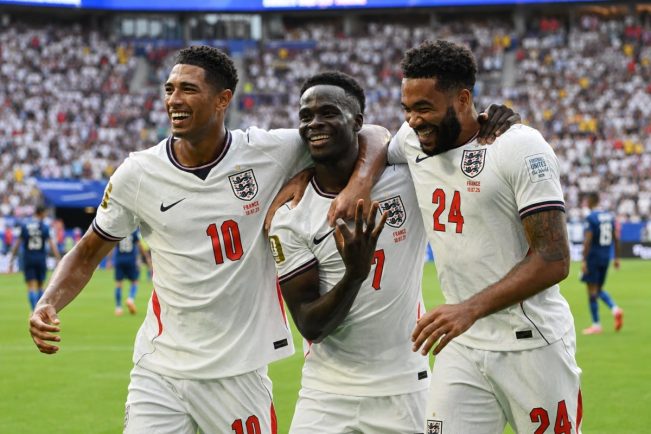
Last night in Miami, England didn’t just win a football match, they put on an absolute masterclass, a six-goal, hat-trick-laden, jaw-on-the-floor spectacle that had the Hard Rock Stadium buzzing and had every neutral in America suddenly wishing they’d been born on this sceptred isle.
6-4 against France. Bronze medal secured. Best World Cup finish since 1966. Rocket emoji. St George’s flag emoji. You know the drill.
Let’s be crystal clear about what happened here, because the numbers alone don’t do it justice. Four goals up at half-time. FOUR. Declan Rice, captain for the night, absolute colossus, opening the scoring with a finish so clean you’d think it came out of a 3D printer.
Then Ezri Konsa rising like a man who’d been personally offended by gravity. Then Bukayo Saka, twice, showing exactly why benching him for the semi-final is a conversation England will be having for years.
By half-time it was 4-0 and the stadium didn’t know whether to laugh or applaud. Both, frankly. Both is correct.
Yes, France clawed back into it. Yes, there were nerves. Yes, for about twenty minutes it looked like Atlanta all over again. But here’s the difference, and it’s the whole point: Thomas Tuchel didn’t blink. No panic. No retreat into some bunker formation with five centre-backs standing around admiring the turf.
He brought on Jude Bellingham and Elliot Anderson, attacking substitutions, more steel in midfield but never a surrender of ambition, and England saw it out like champions. Bellingham capped his tournament with a driving, surging, no-nonsense goal that was the perfect full stop on England’s best World Cup showing in nearly sixty years. Djed Spence won a penalty. Saka dispatched it for his hat-trick, the first England World Cup treble since Harry Kane in 2018. Bronze medal. Heads held high. Absolutely magnificent.
And can we talk about how England did it? Because this is the bit that actually matters. This wasn’t backs-to-the-wall, niggling, time-wasting, shirt-tugging football. This was England playing with freedom, flair, ambition, Saka gliding past defenders like they were cones in a training drill, Rice pinging passes around like a Tube map come to life, Bellingham doing what Bellingham does. Clean. Sporting. Relentlessly positive. A credit, an absolute credit, to this nation. If you want to know what English football looks like when it trusts itself, this was it.
Now let’s talk about Argentina
Because someone has to.
Whatever happens in the final, Argentina should hang their heads. The football world watched an England side get out-pushed, out–shoved, and out-cynical’d in that semi-final by a team that seemed to think certain rules were optional. Grabbing shirts. Punching the back of a neck here. Pushing off balance there. The whole theatre of falling over clutching a shin that hadn’t been touched after they’d just pushed their opponent to the floor. It’s not football, is it? It’s WWE with shin pads. And the truly damning thing is that when England, a team that had just put four goals past a World Cup semi-finalist inside 45 minutes without so much as raising a voice, met a team playing the way football is meant to be played, they walked it. It’s only against the pullers and grabbers and dirty tricks that England came unstuck. Draw your own conclusions. We have.
Argentina may still lift a trophy this weekend. Fine. Trophies gather dust. Reputations don’t. The world has had a good long look at how that Argentina side conducts itself, and however many stars are on that shirt, style isn’t one of them.
And let’s not forget their players posing with that banner the moment the final whistle went. Fans back in Buenos Aires burning England flags in the street and parading a coffin draped in the Union Jack, like beating a football team was some sort of national liberation. That dreadful banner, and the flag-burning that followed it, says everything about the mentality on show. Pathetic, really.
England, by total contrast, leave this tournament with their dignity, their swagger, and the genuine affection of a neutral American crowd who turned up for an “exhibition” third-place match and left having seen one of the great World Cup goal-fests. That’s not nothing. That’s everything.
And a word for the other true winners: Norway
If England were the story of substance, Norway were the story of the heart, and frankly the whole tournament is better for them having been there. Twenty-eight years away from the World Cup, a nation of five and a bit million people, and they turned up and absolutely lit the place up.
Beating Brazil, five-time World Cup winners Brazil, to reach their first-ever quarter-final is one of the great World Cup fairy tales of the modern era, and the “Viking Row” became the single most joyful image of the entire tournament: thousands of fans sitting down in unison, rowing imaginary oars, chanting “Ro!” like it was the most natural thing in the world.
Even after England edged them out in extra time in the quarters, Norway left with the world’s heart in their pocket. Erling Haaland became a global phenomenon almost by accident, simply by being ruthlessly, joyfully brilliant. Football needs teams like Norway. The whole world fell for them, and rightly so.
Roll on 2030
So here’s where we land. England: bronze medal, best finish since ’66, playing attacking, attractive, honest football all the way to the final whistle. Argentina: exposed as bullies dressed up as footballers, and worse off for it whatever silverware they end up with. Norway: the neutrals’ darlings, proof that romance still has a place in this sport.
England go home with their heads high and a squad that is, frankly, only going to get better. Bellingham, Saka, Rice, Konsa, a manager learning fast from every mistake, this is a team on the way up, not a team that’s peaked. Third in the world right now. Not bad. Not bad at all.
But this is just the beginning. Four years from now the World Cup heads to Morocco, Portugal and Spain for its centenary edition, and England will arrive as a team that knows exactly what it’s capable of. England didn’t win this one. Fine. Noted. Filed away.
But 2030 is ours. It’s coming home.
Main image: For illustration purposes only